YARN - From the (shorter) Oxford English Dictionary:

Spun fibre of cotton, silk, wool, or flax.... fibre prepared for use in weaving, knitting...a fisherman's net...any of the strands of which a rope is composed...a (usually long or rambling) story or tale, especially an implausible, fanciful, or incredible one.


Saturday, December 3, 2011

Waldorf and Computers - More high-tech Low-tech


By Rehema Ellis
NBC News

From the moment you walk into the Waldorf School of the Peninsula there are clear signs that something different is happening.

Allysun Sokolowski, a third-grade teacher,  greets each one of her 29 students by name and shakes their hand as they enter the classroom. It's easy for her because she's known these kids at the Los Altos, Calif., school for a while.

"I've been teaching the same children from first grade, second grade and now we're in third grade. And I will teach these children all the way through eighth grade," she said.

It's the Waldorf way.

Teachers establish a strong bond with students. As a result, Waldorf teachers quickly point out there's no need for tests or grades.

"I don't need grades to know how well they're doing," said Sokolowski. "I know their strengths, I know their weaknesses. I know what will be hard for them and where they will shine. I'm their teacher with a capital 't.'"

The intense student-teacher connection might help explain why students from elementary to high school are thriving. The school boasts a nearly perfect graduation rate.

Despite being in the heart of Silicon Valley, Waldorf students are not caught up in the gadget frenzy that has consumed so many other school children nationwide. Computers are not used in the elementary school and they are used sparingly at the high school level. Teachers say they're not anti-technology, but, as they put it, they're just in favor of healthy education.

"I'm concerned that if we say we need technology to engage students we're missing the fact that what engages students is good teachers and good teaching," said Lisa Babinet, a Waldorf math teacher.

I asked a group of high school students if they misssed having computers and iPads as part of their lessons they all emphatically said "No."

The San Antonio Elementary School focuses on technology and feels it helps close the achievement gap in under-served communities by getting students ready for the digital age.

"I don't think we're gonna be left behind at all because it's not like we're not a part of technology at all," said sophomore Isabelle Senteno. "We are a part of it, we just don't incorporate it in the lessons."

Jack Pelose, a freshman who transferred to Waldorf from a school that used a lot of technology, said he noticed the benefits of not using computers in class. "My cursive has gotten a lot better since I've been here," he said.

"Everything about technology is so easy to pick up and use nowadays," added senior Zach Wurtz added. "The companies design it so anyone can use it when they choose to."

The students talked about being annoyed sometimes when they hang out with friends who are not Waldorf students, who spend a lot of time on social networking sites and texting.

One Waldorf student said he sometimes has to ask his friends to put down the gadgets so they can just talk.

And if you're wondering, like I did, how the Waldorf education translates in the outside world, Laila Waheed, a graduate now in her first year of college, offered some insight.

Waheed, 18, has a laptop but never takes it to lectures. She takes notes by hand -- like she did at Waldorf -- and she later transfers her notes into her computer. It's a form of studying, she said.

"If you stood at the back of the classroom and looked at every screen, at least half of them would be on Facebook," Waheed said of all the other students who are typing away on their laptops during lectures.

"A Waldorf education gives you a foundation to say, 'OK, I can put my phone in my bag. I can have a half-an-hour conversation with a person. I don't need to be totally connected all the time,'" Waheed said. "And that's more valuable for making personal connections that will last longer than the next text you're going to get."

It sounds like something a Waldorf student would say. But it’s also a sentiment echoed by her father, an engineer manager at Cisco.

"I don't think anyone is debating the value of technology and the use of computers," Muneer Waheed said. "There is no going back. This is the future."

But he and his wife have been clear about wanting the mostly technology-free zone that Waldorf provides for their two children.

"They need the environment and the foundation to develop and get their core values -- the love of education and their own passion," he said. "That's what's going to stay with them. The computer is just a tool."

all fo this from MSNBC

Tuesday, November 15, 2011

Lantern Walk 2011


The Story of St. Martin
Once upon a time there was a young man named Martin. He was kind and gentle. One day he was going to the city of Amien. As he walked along the country road he rejoiced at seeing the tall trees with their branches swaying in the breezes and flowers of many colours growing from the ground and at hearing birds chirping and singing.
He said, “The world is good” and felt happy to see the trees and flowers and hear the birds.
The sun shone down on him and he felt its warmth on his shoulders.
Soon he came to the gate of the city of Amien. He walked through a large archway. The sun was fading and it began to get dark so he lit his lantern. As he walked along he came upon a man crouched on the ground shivering and cold with hardly any clothes on. Martin took off his cloak, tore it in two and laid one half over the shivering man and gave him his lantern so he would have warmth and light.
Then he went on until he came to his place of rest and lay down on his bed and went to sleep. While he slept he had a dream. In his dream there was an angel who said, “Thank you for giving part of your coat to the shivering man and your lamp so he could have warmth and light. Your name shall be St. Martin.  Again and again St. Martin gave clothing to those who were cold and food to the hungry and light to those in need.

Monday, November 7, 2011

Waldorf Myths and Realities - Reading and Writing

Myths 
- Waldorf kids don't learn how to read
- Waldorf kids are 'held back' or 'delayed' in acquiring core academic skills

The early childhood focus on stories that are expertly told by the teachers and often acted out with puppets or wooden or woollen toy props is not just a nice thing, it is the beginning of literacy in Waldorf education.   The children, through experience, learn what a good story sounds and feels like. They  know that there is a beginning, a middle and a conclusion. They learn how to introduce characters and develop plot. They learn by example the cadence and flow of a good story.  

For many days or even weeks the children hear a story and learn it effortlessly by heart.  Not through drills or rote memorization - through integration and interest.

In this way I have seen both of my children develop excellent (though still at times selective!) listening skills and attention spans. And now my son, in pre-kindergarten, can tell us at supper the stories he has learned at school. My daughter, in grade two will tell stories from her memory and her imagination. Now though she will also write and illustrate them in books.  

The experience of watching my daughter learn stories aurally in the Kinder and Morning Garden classes was tinged with the same fear that many parents have when they see other children of a similar age reading or using electronic devices aimed at developing literacy.  But to watch her, along with her friends and classmates, dive into literacy in grade one was a beautiful thing. They were ready and were strong out of the gates.  They learned to draw forms and structure their drawings, they learned the alphabet and began to write letters and words. Now they write sentences and paragraphs and read the stores they have written.  It all seems so effortless, so painless, so fun and natural. This speaks to the pedagogical progression and to the gifts of the teacher who gently lead the students along this path.

So, what have I learned?  I trust the process.  Waldorf kids learn to read and write for sure, but first they learn to listen and to see.  From the whole to the parts, rather than the other way around.

For your viewing pleasure I offer two videos by Eugene Schwartz on the subject of Writing and Reading in Waldorf Education.


This link will take you to another blog post on How reading is Taught in Waldorf School, from the perspective of a Waldorf trained teacher.

Thursday, October 27, 2011

Low-tech High-tech - Waldorf and computers - 1

One afternoon I came into the school yard to collect my daughter and above the din I heard one of the older boys bellowing; I turned to see him racing across the yard, chasing someone and calling out "he's got my laptop!"

It was the mention of a computer that made this one comment stand out above all of the excited chatter and play. I though "How very un-Waldorf". A few seconds later I saw him running back across the yard with his "laptop" under his arm - and I realized it was two pieces of wood! I could only think - "How very Waldorf!"

A few months later my daughter set up a workspace in our backyard. She has made other places of work, stores for selling stones she has cracked, or play food made from sand and things found in the garden, she has made art galleries and theatres. This time it was an office, complete with a computer - another wooden computer!


Computers are not part of the classroom at our school.  The classrooms contain blackboards, wooden desks and the children learn to draw and print and then to write - cursive writing.

Is this a quaint anachronism? Are we a bunch of Luddites?
Won't our children lag behind?  What will happen if they don't learn to use a mouse before they enter the grade school? Are the wooden computers an expression of need or a sign of profound deprivation?


I see technology changing so rapidly that it makes no sense to learn anything other than for immediate application. The interface with all things technical is becoming more seamless and intuitive all the time, it is not something that needs to be practiced. People don't need extra lessons in video games, or wasting time on the internet, that is the easy stuff. We should not kid ourselves that anything we could teach children now about computers will be applicable in 5 years.  We need to help them to maintain their sense of wonder and imagination, to foster their creativity and to acquire the cognitive skills and sense of historical context and give them access to the great stories of humanity so that they are prepared for a future that we cannot even imagine. It's about thinking, the technology is just a tool.

It turns out that some of the folks who are actually creating these technologies, the earliest of early adopters of technology, the geekiest of the geeky, the disciples of Steve Jobs and Bill Gates, the dwellers of Silicon Valley agree! And they send their kids to Waldorf Schools!

The New York Times, in a series called Grading the Digital School, looks at the results of the push for technology in the classroom. The third article in the series, A Silicon Valley School That Doesn't Compute, focuses on Waldorf education.

Maybe they have wooden laptops there too.


Tuesday, October 18, 2011

The First Day of School

Last year I wrote about Ritual and Reverence and included the first day of school as both a ritual and an act of reverence:
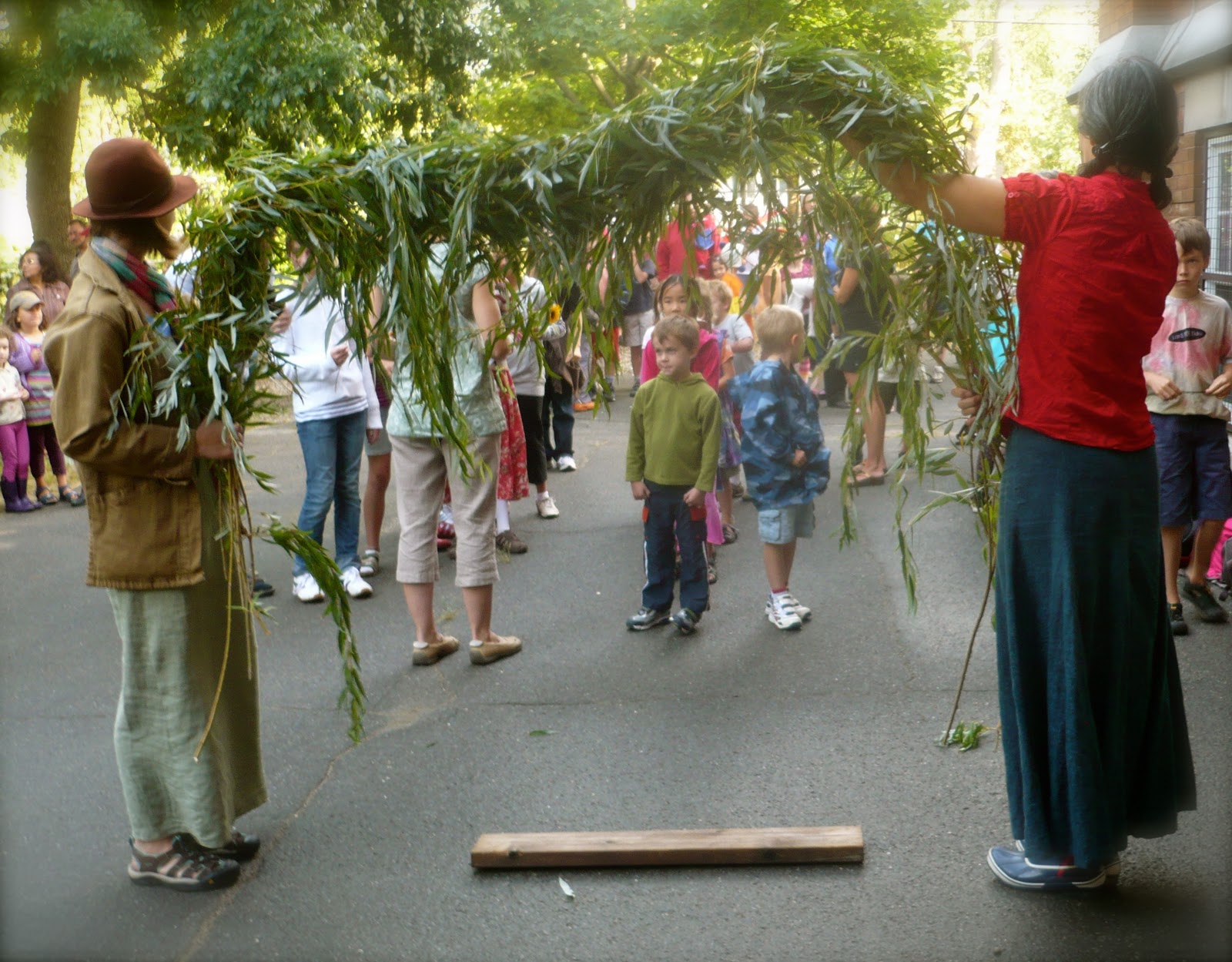
As my daughter entered grade 1 this year I was moved to be standing in the circle of the school community with other parents, children and teachers all of whom had gathered to welcome the children to the grade school in word and song.  Each child was given a flower by a student in the graduating class with whom they had been paired, a gift that will be returned at the end of the year when those same students prepare to leave for high school.  On that first day my daughter and her classmates crossed the threshold into their formal education by passing under an arch of boughs held by their teachers from Kindergarten and in turn they each leaped joyfully into their education.


I was moved by this simple ceremony again this year.  Joining us were new children and new families. Missing from the circle were families that had moved away.  As I looked around the circle I saw all of standing there together and I thought of all that had happened within this community of people in the last year, the multiple ways in which we come to know each other by sharing the experience of being a school community.  Some had suffered losses that touched us all.  We had also acknowledged and celebrated the successes and joys, big and small. These events happened in the context of the school community and connected us further - as friends. 


The school year began with parents and children joining with teachers and staff to mark the beginning of the year, to welcome new students and teachers, to hear what the work of each class will be over the year and to celebrate the teachers who will create the magic that is learning. We also gathered to shine a special light on the children entering into the grade school.  Under an arch of sunflowers, the students and teachers passed from the communal space of the yard, into their classroom homes. New students were welcomed with a potted plant to care for. My daughter returning to a new grade but to  her classroom with her teacher - the same as last year. She was carrying the plant she had been given to care for at the beginning of last year; returning to her desk where her coloured pencils and crayons waiting for her, her knitting project was also waiting in the classroom.  


Ready for the new but eased and comforted by the familiar, there had been very little anxiety or nervousness associated with the beginning of the school year, my daughter knew what to expect. We parents, left in the yard, paused for a few moments to let the emotion runs its course, and to share with each other how surprisingly moving it all is every year.


Thursday, July 21, 2011

Sunday, June 12, 2011

Nature's Classroom


Let Nature be your teacher. 
William Wordsworth


Those who contemplate the beauty of the earth find reserves of strength that will endure as long as life lasts. 
Rachel Carson


What do parents owe their young that is more important than a warm and trusting connection to the Earth…?
Theodore Roszak, The Voice of the Earth


Teaching children about the natural world should be treated as one of the most important events in their lives.
Thomas Berry


Yes, yes, yes and yes!
So what is happening in education to support this?  What is a forest school?  How close is Waldorf to some of these initiatives?   Below are some of the things I found while sitting inside trolling around looking for exciting things happening outside. There are lots of exiting things, things that can and should act as encouragement for us to spend more time outside - during school and away from school. How can we argue with that?


The Coombes School was covered in The Globe and Mail, November 12, 2010 and the article tells us: "Studies suggest that interacting with nature can help children pay attention, motivate them to learn and improve both classroom behaviour and scores on standardized tests. Neuroscientists and psychologists are investigating why nature is good for young brains and how being around trees and shrubs helps recharge the circuitry that children use to focus on a page of fractions or a spelling test." All of this makes sense to me, I have not yet found the research papers, but would love to see them for confirmation of what I already believe to be true!

But what of the actual 'forest schools', what are they?
"A forest kindergarten is a type of preschool education for children between the ages of three and six that is held almost exclusively outdoors. " Forest Kindergarten, (wikipedia).  This article gives a bit out background and arguments in favour of Forest Schools. There are also links to some existing programmes in Scotland, England, Germany and Scandanavian countries.  It sounds like a lot of the things I value at our school, and makes me wonder if we could push the amount of outdoor time even more.

Closer to home, CBC profiles a Forest Pre-school on the Carp Ridge outside Ottawa, at the Carp Ridge Learning Centre.


Outside Thunder Bay is The Forest School:


I'm a teacher, get me OUTSIDE here! is a blog from the perspective of a teacher and outdoor education consultant.


Outdoor play and learning, an online resource about just that.


All of this makes me wonder how we, as a family,  can spend more time outdoors and can help the school to move more education outdoors, to expand our definition of classroom.  May an awareness of variety and options be the beginning of this discussion!


"Must we always teach our children with books? Let them look at the mountains and
the stars up above. Let them look at the beauty of the waters and the trees and
flowers on earth. They will then begin to think, and to think is the beginning of a real
education.” 
David Polis


top of page quotes from Nature for Kids blog